The Piano Keyboard: A Gateway to Musical Expression
The piano keyboard is known as the most iconic interface in the world of music. From the grand concert halls of Vienna to the quiet corners of modern living rooms, its alternating pattern of black and white keys has acted as the foundation for centuries of composition. The piano keyboard acts as a masterpiece of both engineering and ergonomics, and has been designed to put a massive range of sound—from a thunderous bass to a bird-like chirp—directly under a player’s fingertips.
1. Anatomy of the Standard Keyboard
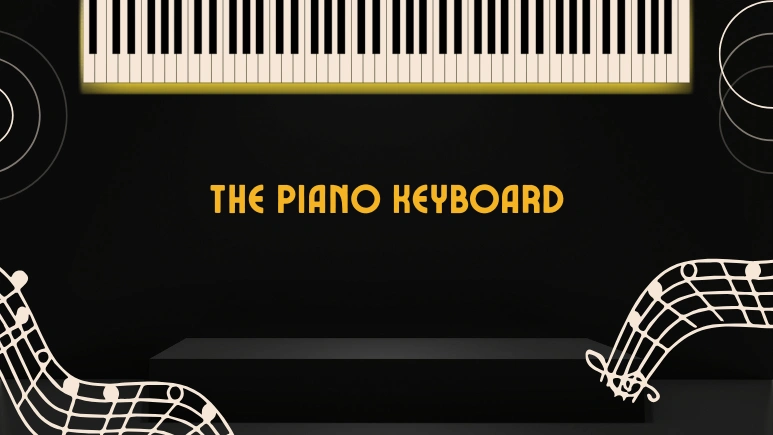
A modern, full-sized piano keyboard has 88 keys. This standard was popularized by Steinway in the late 19th century and became the industry benchmark.
- The White Keys (Naturals): There are 52 white keys on a standard piano, representing the “natural” notes of the musical alphabet: A, B, C, D, E, F, and G.
- The Black Keys (Accidentals): There are 36 black keys, which have been grouped in alternating sets of two and three. These keys represent the sharps and flats (e.g., C# or Bb).
- The Octave: The distance between one note (like C) and the next version of that same note, higher or lower, is known as an octave. Within one octave, the keyboard will have 12 unique notes (7 white and 5 black).
2. Historical Evolution: From Harpsichord to Piano
The keyboard’s evolution is a story of technological progress meeting artistic demand.
The Early Ancestors
Before the piano, people used to use the harpsichord and the clavichord. In a harpsichord, the strings are plucked by a quill. A player did not have almost control over volume; clicking a key harder didn’t make a louder sound.
Cristofori’s Breakthrough
Around 1700, Bartolomeo Cristofori, an Italian instrument maker, invented the gravicembalo col piano e forte (harpsichord with soft and loud). Bartolomeo Cristofori used the plucking mechanism with hammers. As a result, a keyboard started responding to the player’s touch—a revolutionary change that gave birth to the “pianoforte.”
Why are the keys black and white?
Early keyboards often had the colors reversed—white accidentals and black natural keys. This was partly aesthetic and partly functional, as boxwood (white) and ebony (black) were the available materials.
3. How the Keyboard Works: The Action
The “feel” of a piano keyboard acts as its action. When the player presses a key, a complex series of levers (the “action”) produces a felt-covered hammer against a string.
- Acoustic Pianos: Use physical hammers and strings. The keys are “weighted,” meaning they have a specific resistance because you are literally moving wooden parts.
- Digital Keyboards: These use sensors to trigger recorded samples of a piano. To mimic the feel of an acoustic, high-end digital pianos use “Weighted Hammer Action” to provide the same tactile resistance.
4. Layout and Navigation
If you are a beginner, the keyboard may similar to an endless sea of identical keys. On the other hand, the pattern is quite simple once you recognize the black keys.
- Finding “C”: The note C is always the white key directly to the left of the group of two black keys.
- Middle C: This is the most important landmark on the keyboard. It is located roughly in the center of the instrument and usually acts as the dividing line between the left hand (bass clef) and the right hand (treble clef).
- The Repeating Pattern: Once you learn the notes in one octave, you will have full knowledge of them. The pattern is simple, repeating across the entire 88-key span.
5. Types of Modern Keyboards
While the 88-key acoustic piano is the gold standard, the digital revolution has introduced various specialized keyboards:
| Type | Key Count | Best For |
| Digital Piano | 88 Keys | Students and home use |
| Synthesizer | 37 – 61 Keys | Sound design and electronic music; |
| MIDI Controller | 25 – 88 Keys | Computer-based production |
| Workstation | 88 Keys | Professional performers |
6. The Keyboard as a Compositional Tool
The piano keyboard is the primary tool for music theory and composition. And the notes will be seen laid out linearly; it is incredibly easy to visualize intervals, chords, and scales.
In a choir or orchestra, a singer or violinist can only play one note at a time (monophonic). A pianist can play 10 notes at once (polyphonic). This makes the keyboard a “mini-orchestra,” allowing a single musician to play melody, harmony, and bass lines simultaneously.
7. Maintenance and Care
A piano keyboard is known as a sensitive piece of equipment. The acoustic pianos are made mostly of wood and felt:
- Humidity: High humidity causes wood to swell, leading to “sticky keys.”
- Temperature: Fluctuations cause the strings to expand or contract, pulling the instrument out of tune.
- Cleaning: Never use harsh chemicals on the keys. A slightly damp microfiber cloth is usually enough to remove finger oils.